Tag: watercolor process

  • Presence in the Moment: Watercolor Surf Art

    Presence in the Moment: Watercolor Surf Art

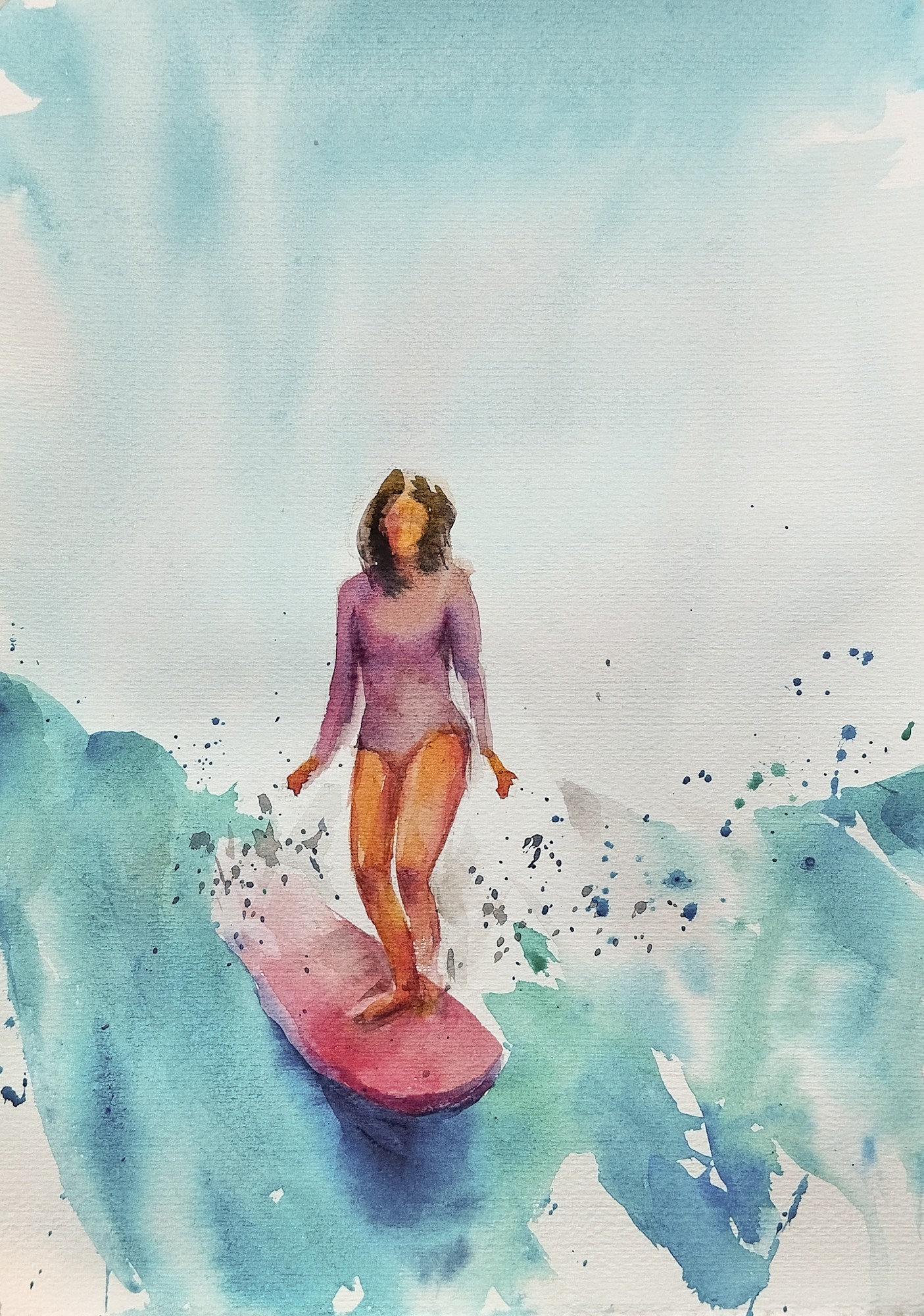
    The moment when a surfer rises on the wave, the world falls away. There is no past, no future, only now. This is what i’ve sought to capture in this watercolor: a study in presence, where everything else dissolves into irrelevance, and only the breath, the body, and the ocean remain.

    The Dance of Concentration

    When you stand on a wave, you cannot think, everything is instinct. You can only be. And this is precisely what makes the surfer’s moment so close to meditation.

    This piece explores that sacred space where concentration becomes so complete that all distraction vanishes. The surfer exists in absolute presence, her awareness narrowed to a single point: the dance between herself and the water beneath her feet.

    The Colors

    The palette is intencional. The water flows in emerald green and turquoise blue — luminous tones that suggest the ocean’s clarity and its movement. These jewel tones create a soft meditative quality.

    Against this, the surfer is painted in cadmium yellow and hints of scarlet red — warm, vital colors that anchor her. The contrast is stark, intentional: she is present, alive, here, while everything else melts into the abstraction of water and light.

    The Language of Watercolor

    Watercolor is the perfect medium for this. Its transparency and lightness mirror the very nature of water itself. Nothing is forced, nothing is solid. The pigment flows and mingles, just as the waves and the ocean currents. There is no room for rigid control here, only surrender to what emerges.

    Notice how the colors bleed and dissolve at the edges — this is not imperfection. It is the world beyond the moment, rendered abstract and irrelevant. The surfer’s form remains sharp, intentional, real, while everything else becomes suggestion, shadow, breath.

    An Invitation to Stillness

    This is what I believe at IVOILUSTRA: that presence is a practice, and that the ocean teaches it better than any philosophy. In this watercolor, I offer an invitation to step into that moment where thinking stops and being begins.

    The wave teaches. The surfer listens. The moment is all there ever was.
  • The Freedom of a Loose Sketch — Watercolour as Daily Meditation

    The Freedom of a Loose Sketch — Watercolour as Daily Meditation

    There’s a version of watercolour painting that’s careful, measured, planned. The reference photo pinned up, the composition sketched out, the colours mixed and tested before touching paper. I do that version too.

    But the version I come back to every day — the one that keeps me sane, keeps me honest, keeps me improving — is the other one. No reference. No goal. Just pigment, water, and whatever my hand decides to do.

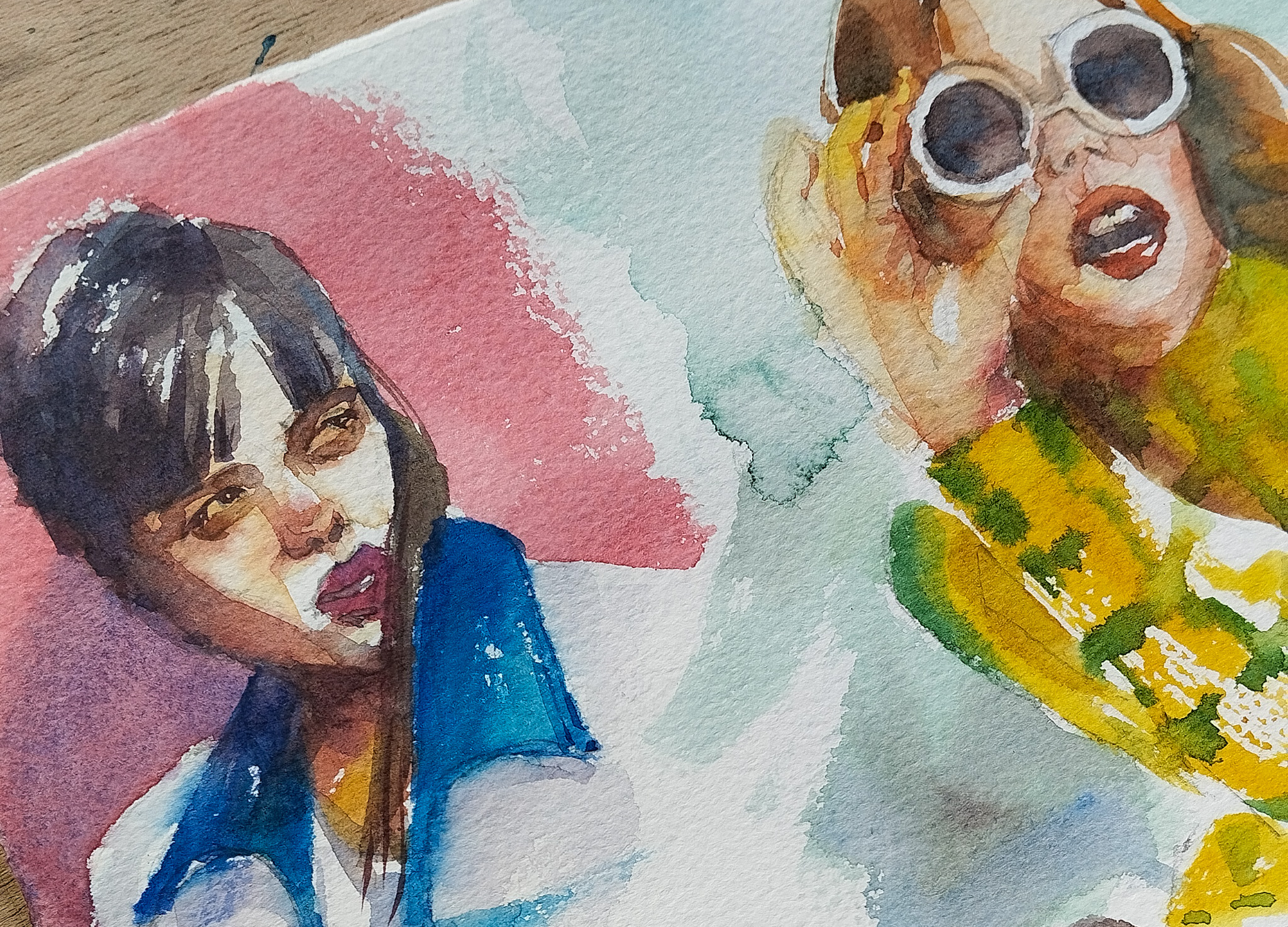
    Sketching freely with watercolours, without thinking about the result, is an inexplicable pleasure. It’s also, I’ve come to believe, the most important practice a watercolour artist can have. Not the commissions, not the finished pieces. This — the daily loose sketch. My meditation.

    Why Loose Sketching Makes You a Better Artist

    When there’s nothing at stake — no client, no finished piece, no Instagram post planned — your hand starts to move differently. More honestly. The marks you make when you’re not trying to impress anyone are often the most interesting marks you’ll ever make.

    Loose watercolour sketching builds the muscle memory that makes confident painting possible. The instinct for how much water to load onto a brush, how far a pigment will bleed, when to stop. These aren’t things you can think your way into. They come from repetition — and the most painless repetition is play.

    Loose watercolour sketch daily practice by IVOILUSTRA

    The Practice

    My daily sketch has almost no rules. Wet the paper or don’t. Pick colours that feel right, not colours that are correct. Let shapes emerge rather than drawing them first. If it fails, turn the page. There are no failed sketches in a practice journal — only information.

    Most of my best ideas for finished paintings came from these sessions. A colour combination that surprised me. A mark that suggested a wave I hadn’t thought to paint. The loose sketch is where the unconscious gets a say.

    If you paint — or want to start — this is the one habit I’d recommend above everything else. Fifteen minutes a day, no pressure, no audience. Just you, a brush, and whatever the water decides to do.

    The prints in my shop are the finished, considered versions. But they all started somewhere close to this.

    From surfers, to surfers.

  • Longboard at Estoril, Lisbon — A Perfect Wave, a Watercolour Painting

    Longboard at Estoril, Lisbon — A Perfect Wave, a Watercolour Painting

    Praia do Estoril doesn’t get talked about the way Ericeira or Nazaré do. It’s not a big-wave spot. It doesn’t have a world-famous reef. What it has is something harder to find: consistency. When the wind and the swell align, Estoril delivers a long, peeling wave that runs down the beach in a way that feels almost too good to be real.

    It’s a longboarder’s wave. Patient, readable, generous. The kind that lets you walk to the nose, hang five, turn back, and do it again before the wave finally gives out in the shallows. I surfed it one afternoon when everything clicked — and came home and painted it before the feeling left my body.

    Longboard surfer riding a perfect wave at Estoril Lisbon, watercolour illustration by IVOILUSTRA

    Painting the Wave While the Memory Was Still Fresh

    This is how most of my surf illustrations start: in the van, immediately after a session, with the memory of the wave still physically present. The paddling fatigue in the shoulders. The salt still on the skin. That state is the best reference a watercolour artist can have — not a photograph, but a felt memory.

    The figure in the painting is riding with that particular longboard ease — upright, unhurried, reading the wave rather than fighting it. That’s what Estoril does to you. It slows everything down and makes the ocean feel approachable again.

    The short video below shows the painting coming together — from the first wash to the final marks.

    I have a feeling there’s a lot more to come from this stretch of coast. The Atlantic doesn’t run out of waves. And I haven’t run out of reasons to paint them.

    Prints available in the shop — worldwide shipping, 4–9 days. More process videos on YouTube.

    From surfers, to surfers.

  • Processo Criativo de uma Aguarela — Do Esboço ao Resultado Final

    Processo Criativo de uma Aguarela — Do Esboço ao Resultado Final

    Cada aguarela começa da mesma forma: um esboço a lápis, rápido e sem detalhe. O único objetivo desta fase é definir a composição e o contraste — onde está a luz, onde está a sombra, como o olhar vai percorrer a imagem. Nada mais.

    Depois de receber a fotografia, o esboço a lápis serve para tomar todas as grandes decisões: onde a figura vai estar na folha, que zonas vão ser mais escuras, onde o branco do papel vai brilhar. É sempre um esboço muito rápido — cinco minutos no máximo. O detalhe vem mais tarde. Primeiro, a estrutura.

    Esboço a lápis para aguarela personalizada, definindo composição e contraste. IVOILUSTRA

    A primeira aguada — húmido sobre húmido

    Com as decisões tomadas, começa a aplicação da primeira camada de aguarela. É aqui que a atmosfera da pintura ganha forma — as cores dominantes, a temperatura da luz, o tom emocional geral. Esta fase é feita sempre com a técnica húmido sobre húmido: o papel é humedecido primeiro com água limpa, e a tinta é aplicada enquanto o papel ainda está húmido. O pigmento espalha-se de forma orgânica, cria transições suaves e gradientes que nenhum pincel consegue fazer quando o papel está seco.

    Primeira aguada em aguarela, técnica húmido sobre húmido. IVOILUSTRA

    Os pormenores finais

    Depois do papel completamente seco, é hora dos pormenores. Esta é a fase que exige mais cuidado — é muito fácil estragar uma aguarela aqui. Com pincel fino e as cores certas, são adicionados os meios tons, as sombras mais escuras, os detalhes que dão vida à expressão de um rosto ou à textura de um tecido. O segredo é saber parar a tempo. Uma aguarela termina antes do que pensamos.

    Aguarela personalizada finalizada, retrato de animal de estimação por encomenda. IVOILUSTRA

    Depois de seca, a pintura é embalada com cuidado e enviada para a morada que nos indicaste. O resultado: uma obra de arte original, única, feita à mão especificamente para ti.

    Se quiseres encomendar uma pintura personalizada, basta ir à página de contacto e enviar uma mensagem com a tua fotografia. Respondo sempre.

    Feito à mão, com atenção ao detalhe.

  • Personalized Watercolour Painting — Turning Your Photo Into Art

    Personalized Watercolour Painting — Turning Your Photo Into Art

    There’s a photograph somewhere on your phone that you look at differently from the others. A moment with someone you love, or a place that changed something in you, or a face that you want to keep seeing even as time moves on. That’s the photograph I work from.

    Transforming a photo into a personalized watercolour painting is one of the most meaningful commissions I take on. Not because it’s technically demanding — though it is — but because the result matters to someone in a way that a print never quite can. It’s a unique object. There’s only one.

    The Three Stages of a Watercolour Commission

    The photos below show the three stages of this particular painting in sequence. Each one is a different technique — and each technique has a specific purpose.

    Stage 1 — Wet on wet. The paper is wetted first and the first colours are dropped in while it’s still damp. The pigment spreads organically, creating the soft atmospheric background that watercolour is known for. This is where the mood of the painting is decided.

    Stage 2 — Wet on dry. Once the first layer is completely dry, I work on top with a loaded brush on dry paper. This gives me control — sharper edges, deeper shadows, the beginning of form and structure.

    Stage 3 — Final details. The last stage is the most delicate. Fine brushwork, careful observation of the reference photo, and the restraint to stop before doing too much. A watercolour portrait is finished earlier than you think.

    Commission Your Own Watercolour

    If you have a photograph you’d like turned into a one-of-a-kind watercolour painting — a portrait, a family moment, a surf session, a place that matters to you — get in touch via the contact page. Share the photo, tell me a little about what it means to you, and we’ll go from there.

    Every commission is different. Every painting is unique.

    From surfers, to surfers — and to everyone who has a moment worth keeping.